Posts

Showing posts with the label Notes to Self

My theme for 2024: Yes, and ...

It's been a while since I posted. Hello, I'm still around. It's late to be posting about the start of 2024, but, as always, it's better late than never. 

First, I do have a theme for 2024, and I thought of it way before Ariana Grande released it as a single: Yes, and ... I picked it up from improv. It refers to the kind of thinking where you accept what another improviser has said and build up on it. 

I figure this year is the year I tame my overthinking and automatic mental rejection of the unfamiliar. This year will also be the year I teach myself to be more accepting of opportunities that come my way. 

Yes, Universe, and ...


Late to Ben&Ben

"Because all of this comes with a love that is real."

What do you call it, freedom or loneliness?

"And when nobody wakes you up in the morning, and nobody waits for you at night, and when you can do whatever you want. What do you call it, freedom or loneliness?" - Charles Bukowski

I saw this quote again on Facebook. I used to have a hard time understanding how loneliness felt. I could always find happiness in my own company. What I felt more strongly was the invasive concern, if you can call it that, of people who found something wrong with my being alone.

I'm grateful for the friendships that found me by myself, yes. All my friends, I believe, found me and pulled me in and never let me go (except for Sherwil; I think I found her but it was she who never let me go, haha). But if they hadn't, I don't think I'd ever be lonely if I were left alone.

What made me experience loneliness was being in the company of the wrong people.

I hope I never make anyone feel lonely in my presence. And if I have, I'm sorry and I hope never to do so again.

Love nowadays

In my age now, I think I hold on to love not because of the person but because I still can't accept that people just aren't as important as they would have been had I Ioved them in my teens or 20s.

These days, love comes and goes, not leaving an indelible mark, except maybe a guilty sin or two that I no longer take as seriously either, so I scramble to save some significance because of how I loved when I was younger.

That is probably what I cry about: that I refuse to let me and you be easily forgettable; I want to be even a little scarred.

But in my age now I have also forgotten how heartbreak was back then, how I had no sight of the healing that would come, and how, even when I was feeling like I was dying, I wanted to be able to give a mature kind of love that could let go when the time came to do so.

So it is me, not any of the people I loved recently. I still want to love the way I did when I didn't know better, but I can't because I already do.

My theme for 2023: More

I didn't even pretend to make a list of resolutions for 2023, like I have done the past many years. When the new year rolled in, I just sort of surrendered, in a bad way and in a good way. I've been alive long enough to accept that I am always going to be who I am, in a bad way and in a good way. 

I'm done changing myself. And it feels like such a huge relief to openly embrace that there's always going to be something wrong with me and something unlovable about me. 

I know there are good things about me and traits that people do love, but I don't intermittently obsess about minimizing those aspects of me. I don't spend energy magnifying them either, but that's something else I should think about.

But first let me just face my shadow and tell it it's alright for existing. It can come out to play. We can be friends.

***

That being said, my theme for 2023 is More. As in, I want more. From myself, from others, from life. Thank you; more please.

Long time

For some reason, I didn't want to write about the pandemic. Or how life spiraled downwards in the first three quarters of 2020: I ended a bad romance; left a toxic boss who was blind to her mistreatment of people; faced a pandemic, during which a family member had a major health incident; ended another bad romance. I lived through those things, but I didn't want to immortalize them in writing. I actually didn't want to think of them more than I had to. 

Looking back now, having afforded myself the distance that time brings, I'm realizing that my not writing about the bad events in my life and trying not to think of them more than I had to also meant failing to reflect on the grace that was with me every step of the way. 

Bad romances teach love and forgiveness, and an appreciation for life's brief but lasting encounters. I am grateful for these people; they made me feel good things that have outlasted the bad. 

That toxic boss--my first ever, so I navigated poorly--opened me up to the love and support of all my workmates, who not only validated my experience but also saw me through it with their presence. 

It helped that we all had a shared experience; at some point, I actually thought it was just me and I started questioning my perception of things. Leaving my last job, I'd never felt so hated by one person but also so loved by everyone else. But, happily, only that love has stayed.

When my mother had her transient ischemic attack, I was alone with her, but my sister and my younger brother left work and came rushing. It was the height of the pandemic and we couldn't find a hospital who would accept us because all of my mother's vitals were stable. Pandemic-era triage couldn't see her congestive heart failure when her blood pressure and oxygen saturation were normal.

I was afraid, doubly so because of COVID-19, but I kept getting this message each time I prayed: "Be still and know that I am God." My mother is better now, and our family stronger. 

Not writing about the pandemic also meant I didn't write anything about the best thing that happened in 2021: I got a puppy. 

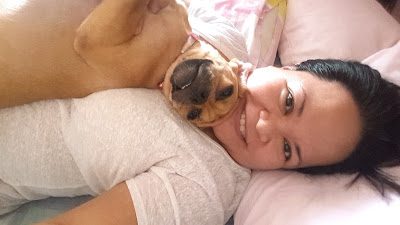
So this is where it's at. Looking at the end of this year, the second of the pandemic, everything is uncertain, but I have the love of a dog. Be still, she teaches me, be playful and hyper and occasionally aggressive, but be still in the moment and appreciate it for what it is. 

Tala and me

The work for which all other work is but preparation

I've been thinking, off and on, of something I once read: The purpose of marriage is not happiness but holiness. Never having been a "good" Christian despite my many attempts, I couldn't understand this line of thinking. Having been raised Catholic, I understood "holiness" to have as one of its main ingredients sufferingand why even want to get married if to be successful at it means to suffer?

But these words never left me, bobbing up every now and then from the flotsam and jetsam of my brain. Until, one day, it dawned on me what the statement meant for me. On that same day, I also realized that I do want the gift of marriage. In fact, that is my Christmas wish this year. 

My view is not a biblical view, but I don't think it strays too far from it. To be holy is to be set apart from others, as God is, in his perfect goodness and righteousness, in his perfect love (yes, this is biblical; yes, I know I said I wasn't looking at it biblically). 

The way I'm seeing this now is that the purpose of marriage is to perfect your loveand there's a lot of work that comes with that: work you do on yourself, work you do for the relationship, work you do to love the other properly. 

Perfect love is unconditional love, and in the past I only understood that to mean you love the other anyway, but now I see better that it means your life (your success, your joys, your everything) is not contingent upon anything that has to do with the other. 

The other is free to be, free of the burden of you, and yet loved by you. That is perfect love, the kind of love that is set apart. 

Happiness, though not the purpose, is the byproduct. 

Still walking this way

Looks like Christmas is still on

My favorite exercise is walking, which, at least for me, is both exercise for the body and the mind. I don't do it often because I don't feel comfortable walking in our villageI could make a long list of things that make walking unenjoyable where I livebut I've decided to give it another shot, because this pandemic has had me getting used to being locked in my small house and I hardly get any exercise. 

The beautiful thing about walking, at least for me, is that as soon as I do it, I am reminded that I do enjoy it, no matter where I am. In college, I walked often from La Salle to CCP and from La Salle to Lawton. When I transferred to UP Diliman, my friends and I would walk from our tambayan beside the now gone FC building to wherever, often Philcoa. When I worked for The Philippine STAR, I'd often walk from Port Area through Intramuros to Liwasang Bonifacio, where I'd catch the bus home.

For a couple of years, I lived in Sampaloc, and I walked on a flooded España Boulevard from Welcome Rotonda to my apartment on Forbes Street (which was actually renamed Arsenio H. Lacson Street in the early 70s, but nobody called it that; they called it Por-bes which I kept pronouncing as Forbes should be pronounced on jeepney rides and nobody jeepney driver ever got me. But I digress.)

So, walking. The longest I've walked in Manila is still during the EDSA 2 revolution, and even then, as we were demanding Pres. Joseph Estrada to resign, I enjoyed seeing the sights along the way from the EDSA Shrine to Shakey's Quirino, I think, where my friend and I decided to hole up in because we'd heard that the rally was going to Malacañan Palace but Erap had already said he was leaving. We were tired and hungry (and hangry) from having been at the Shrine since the day before, so we ditched the rally for an airconditioned and empty Shakey's and was treated to news on TV of Erap exiting the Palace.

When I lived in Project 4, I walked to establishments along Katipunan Extension, like Countryside Restaurant and Kopi Roti and Route 196, and once to White Plains Avenue for a Marcos is Not a Hero rally in 2016. I wished I could walk to Eastwooddistance wasn't the issue; safety was. 

I wish walking around Manila were similar to, say, walking in Paris or Manhattan. But as Carlos Celdran kept saying, if you look close enough, you can still see the city's beauty. I guess that's what walking has done for me: It has taught me the art of looking close enough.

I've been looking closely in my neighborhood again, and taking bad pictures of things I found beautiful. As soon as I stepped out of the house, I saw that our bougainvillea tree was in full bloom after its extreme Typhoon Ulysses trim. Then there was that small brown dog the was on a roofnot a balcony, mind you, but an actual roof--watching me walk by. One of the houses I passed had a collection of hibiscus planted along the fence and they all had flowers. Things like that make my walks interesting.

And then there are the people. Sometimes, at our village commercial centerthe point of my walk where I turn backI buy things, like food or lottery tickets. The other day, I lingered around the lotto stall, and when I finally decided to get a ticket, the man manning the booth saw the shapeless bag I had slung across my chest and told me to roll the piece of paper so it wouldn't get crumpled. It's important to not get it crumpled, he said, his voice both gentle and wise.

That same day, I decided to buy some barbecue at the stall along the village church's creek, seeing that there weren't any people. My bill was P52, but she smiled and charged me only P50. Tonight, my bill was P61, and when I struggled with finding the right coin in my purse, she laughed and said to give her P60.

What I miss is smiling, albeit shyly, at people and making painfully awkward stabs at small talk. Things are more difficult now that I have to wear a face mask and a face shield, and, of course, with this virus basically a talking disease. 

But at least there's still a world to go out to, and I'm hoping so profoundly that it will open up again soon. In the meantime, I'll continue taking walks and looking closelyenough to keep on hoping.        

Let things fade

I think it's ruining me that I am compelled to make every single experience meaningful. One of this year's lessons is: Let things fade into insignificance. Not everything or everyone earns the right to be beautiful in memory, no matter how much they were loved.

On the other hand, there is nothing wrong with wanting things to be wrapped up nicely, if this is who you are. Just know that it is not realistic and it can lead to a lot of frustration and, worse, heartbreak, because only life and the living of it can really reveal the gift of moments you have already lived. 

Some things feel so important now, so overpowering, and yet will surprise you with how small they actually are in the scheme of things. And some things feel so inconsequential but leave a mark. 

You can't always tell which is which, not while they are happening. The only way to find out is to simply live.   

How to make a parol


Disney just featured a parol and parol-making (plus the line "From our family to yours") in its holiday advertising, and I'm reminded of that traumatic parol-making contest that we had in grade school. 

I'm not sure if I'm remembering this correctly, but I think we did it twice--once in Grade 5 and another time in Grade 6--but the star parol was for Grade 6.

What I remember was that we had to order a set of materials from the school and we made part of the parol in school, with the guidance of a teacher (was it Art class?), with the rest of it to be completed at home.

I was given blue and orange tissue paper and some cellophane, just enough for the star and its tail. I don't remember any lights or batteries, so I think it was just supposed to be a basic parol.

I don't remember fixing up the star frame, so it's either the parol set came with a ready star or I didn't have a difficult time setting it up (maybe my father was home and he helped?).

What I do remember is that the night before the parol was due, I was crying because I did not know how to use paste with tissue paper and the whole damn thing kept sticking to my fingers. As for the cellophane, the paste just wouldn't hold it in place!

Back then, it was not easy to buy arts and craft supplies in Las Piñas. The only National Bookstore was at the Alabang Twin Cinemas, now Alabang Town Center. The small stores in our village that carried school supplies often didn't have Elmer's glue or tissue paper!

I think my mother helped (and if we had helpers at the time, for sure they helped too), but I still remember crying and panicking the entire time. I had no idea my hands, which I thought capable, could be so inefficient with paste and tissue paper!

To my relief, I was able to finish the project. It was an ugly mess on one side and a more tolerable one on the other. But it was over and done with, could be submitted for a passing grade, then forgotten.

At this point, let me say that at that time, I thought the goal was to make a parol out of the set of materials we were given, and nothing more. If we ran out of the materials, we could replace them, yes, but not add to them.

I was flustered to find out that we were supposed to parade the parols in front of everyone for the contest. I thought we would just hang it somewhere for the judges to look at!

I have always been uncomfortable in any spotlight, and my discomfort was made a thousand times worse because I would have to walk in front of everyone with the abomination that was my blue and orange parol. 

I died a thousand deaths waiting for my turn and looking at my schoolmates' parols, some super elaborate with extra features that definitely did not come with the set we were given. There were lights! A belen! Sounds! 

No way did they make those parols without any help and extra expenses! But that unfair advantage is always glossed over in grade school and high school.

I don't remember how we were asked to fall in line, but I was sandwiched between one beautiful parol and another, and I remember the judges laughing at my poor creation. 

To be fair, they laughed at many others, some uglier than mine.

Once the farce was done, I was so relieved I could finally hide my parol away. I thought about dumping it in the trash, but felt that that would also lead to more attention. So I carried it back home on the school bus, which was filled with lanterns and belens that day.

I thought that was the end of my parol, but I can also remember one more thing: We hung it that Christmas and kept it around for at least another one. I was never proud of it, but I suppose I realized it was pure and it was mine.

Typhoon Ulysses

I'm terrified because of the typhoon howling outside our window, blowing away bits of our house, and so I'm scrounging in my mind for whatever comfort I can find. 

In fear, my mind is asking whether in this pandemic all that is left for us is this endless struggle to survive, and I find myself despairing: That is not a life. 

But in faith, I think of all of you that I have loved and continue to love, in big ways and small ways, whether you knew it or not. And the wind is howling terribly outside our window, but I'm finding little nuggets of peace inside my heart. 

I have a good, though small, life. I've had big joys and small joys. I've had quiet loves and great loves. 

I guess that is really how one measures one's life?

If I regret anything, it's only that I could have been kinder. And maybe nastier to those who deserved it. Or maybe I wish I had been more honest--both in being kind and in ... not. 

I wish I had been more honest with how I feel about people.

***

This day is ending with a lot of fear, but there was also much joy, both additional and continuing: I have a new nephew born today, Andres Gabriel, and my six-year-old niece Kiara lost her second front tooth.

*** 

I used to watch Oprah, back when Studio 23 was airing it and her show was the only positive thing you could see on TV. In one episode, she or a guest mentioned a Christian song that helped her find forgiveness for people who had hurt her and wish them well. 

When I saw that episode, I was hurting and bitter over someone I can barely remember (I was so young!), and I was struggling for the good in me to overcome the bad because I knew it would be better for me in the long run. So I paid attention. 

The song is called, "I Need You to Survive." Maybe it's that S word in the title, but after not having thought of the song in years, I've found myself thinking of it a lot lately. I'll link it below.

*** 

I'm going to try to sleep now. Or maybe find out how long the wind is supposed to be blowing this way.

***

Lizards kiss the ground to pray

When we were children, my mother would tell us to be careful with the house lizards that we saw at home. They were good creatures, she would say, and at six in the evening they would come down from heaven to humbly kiss the ground and pray to God.

I heard this story more than once because it was told to me and my older brother, and it would be told to the brother that came after me and then to the sister that came after all of us. The house lizard, with its fleshy body and skin so thin you could see its bones and pulsing organs; the house lizard, with its self-amputating, regenerating, tail; the house lizard, the holiest of God's animals, so good they have a place in heaven.

When I was younger, I would often worry, "Does God want me to also kiss the ground at six o'clock to show my love?" Then, instead of shamefully saying "Yuck," I would counter, "But God made it easy for the lizards. Their head is so close to the ground." And so for a time, the lizard was a reminder of what this guilty Catholic school girl would not do for God--and yet it was also a symbol of the long list of things I was grateful others would do so I wouldn't have to.

I could never touch a lizard--I imagine the sensation to be like holding a writhing strip of detached skin--but growing up I did keep more than a few lizard eggs we found all over the house. I watched a couple of them hatch into healthy baby lizards, but I also saw many premature hatchlings crawl out of slimy, bloody cracked eggs that were accidentally dropped.

I was sorry every time I saw a lizard, especially one too young to come out of its egg, die. I was even more sorry if I had caused it, though accidentally, like when I squished one with a door or forgot to check if one was trapped in flypaper. It felt like I had deprived God of yet another worshipper--one of, if not the, best. 

When I was a little bit older, I read about nocturnal animals and how lizards crawl out after sunset to eat insects. I tried to connect this with what I had been told as a child, thinking, "So they wake up, kiss the ground in prayer, and then go eat." But also, "Can they be any more good? They kiss the ground, they pray, and they eat mosquitoes!"

(And also, my eternal conundrum: Are animals really good if they kill other animals?)

Now I know with the certainty of an adult that my mother's story is just that, a story. And yet, when I saw a lizard trapped in flypaper fairly recently, I could have sworn God asked me to save it. Of course, later, when I was in my fourth hour of gently prying another lizard finger off the flypaper glue that a quick Internet search told me to wet with baby oil, I wondered if I had heard wrong and my messianic complex was again making me interfere with the natural order of things. 

I would like to believe the lizard heard me, though, when I begged it, over and over again, to stop writhing and not drop its tail or else I might make the sorry mistake of killing it as I recoil in disgust.

When finally it was free, it stood looking at me for a moment, and then quickly crawled off into the sunrise. I saw it again a few days later--I recognized it because there were still smudges of golden glue on its skin. I am not sure if I saved it, really, because I left it a bit sticky, but at least I know I gave it extra time (to kiss the ground and pray to God).

I am remembering all these tonight because the past week, there has been a baby lizard, already regrowing a tail, crawling on my bedroom floor from six o'clock onwards. It has kept me from sweeping the floor or using the vacuum cleaner, because, yes, I still do not want to deprive God of yet another worshipper, but also, having already spent five hours of my lifetime hunched over the kitchen sink, painstakingly removing a reptile with twenty fingers I could barely see and easily break with the smallest wrong move from a glue so sticky it is a trap, I do not want to have to save another one.

Now I think I am being terrorized by this baby lizard as much as I am terrorizing myself with stories I have been told and stories I have been telling. I mean, I know better, but there's the lizard, and I can't clean my room for days now because it's praying before eating. 

Bon appetit. Pray for me.
What Agapito Flores gave to me

Fluorescence, like some other names for the phenomena of light, is one of my favorite words. I love that it sounds like the Spanish word for flower and it brings to mind an image of light in full bloom. "Which we perceive with our sense of sight," I would add when I was a child as a sort of fun mnemonic, tickled by my own wit.

Like many from my generation, I grew up being taught about Filipino inventions. There was Agapito Flores and the moon buggy and, strangely, of all things, the rubber toilet plunger. 

In Grade 5, a teacher called on me to answer what I felt was a very difficult question. Which of the following Filipino inventions, she asked, proved that Filipinos were a technologically advanced people? The fluorescent light, the moon buggy, the toilet plunger, the first two, or all of the above?

How was I to know that in my teacher's opinion the understanding of modern plumbing and the application of suction and pressure did not constitute being technologically advanced? Hadn't I spent so many moments in different bathrooms marveling at how the toilet bowl worked? 

She laughed at my answer--the rest of the class laughing with her--and asked for an explanation so they could laugh some more. But I could not give one, because the class was in Filipino and until Grade 4 we were speaking Cebuano at home. I was already fluent in the Tagalog my cousins and playmates spoke, but in school there was this style of affected Filipino being spoken by our teachers and I could never, up to now, speak it.

After that incident, I spent a couple of weeks downgrading my view of the precious but apparently non-technologically advanced toilet plunger, and even now, when I see one, I am reminded of that moment in class although I have long forgotten the teacher.

Looking back now, what I also learned then was the difference between questions of fact and questions of opinion and how it makes people feel when you confuse the two, so maybe it was not all that bad.

But oh, Agapito Flores! Discovering the lie about him was also discovering the beauty of language and logic. Shortly after being taught about Agapito Flores, I encountered the word fluorescence, probably in Reader's Digest or maybe when reading about rocks in the encyclopedia, and then looked it up in the dictionary. 

We had been taught that Agapito Flores was an electrical engineer who invented the fluorescent lamp in the 1920s and then sold all his rights to his invention to General Electric, who developed it further and still named it after him anyway.

But the etymology, the origin story, of the word fluorescence quickly told me otherwise: It was coined in the 1850s, from flour-spar, a mineral which, yes, fluoresces. Another thing that fluoresces? The fluorescent lamp. There was no mention of Agapito Flores at all! 

If the fluorescent lamp was named after this phenomenon, where was Agapito Flores in all this? Nowhere!  

My little world crumbled with the embarrassment of this lie being spread by books and teachers, even in--gasp!--respectable learning institutions. But as quickly as my world crumbled, it also rebuilt itself into something better. 

My brain had always felt dim in school, mostly because in my early years I struggled with language, but I had always suspected there was a spark of intelligence there that could be set alight. And Agapito Flores, whoever and wherever he was, real or not, helped me realize that I was right. 

There are people who would laugh at you for thinking differently than others, and often these are people who are dumb precisely because they think they are already smart. Sometimes, these people are placed in positions of influence over you and they can teach you the wrong things, directly or indirectly. 

But I learned in the same moment I learned about the lie that is Agapito Flores that there was a response to that: I could learn on my own through my own learning paths, no matter how meandering. Outside of school, there were books and other teachers and other sources of learning. And then there was me who was capable of making sense of things, after all. 

This knowledge bloomed in my mind, and has, since then, stayed bright because it was I myself who switched on the light. If there is anything I can remotely attribute to Agapito Flores, it is that.

'Something beautiful is going to happen'

Something beautiful is going to happen, the priest said at mass yesterday. And like Peter, he added, you will say, 'It is good that we are here.'

The priest then told everyone: Hang on; these are sad times, but something beautiful is going to happen. 

I wanted to cry. And I may have a little. 

I didn't know that the readings during Lent are designed to lead one to conversion in preparation for Easter. I don't know what I thought of how the readings are organized for the year. I probably never thought of it at all. 

But reading after reading, since Ash Wednesday mass, and now I think I feel a hand reaching out for mine.

***

Truth be told, I am not yet at the point where I go to mass and say, "It is good that I am here." Sometimes I still feel doubt and boredom and even annoyance. These days, I've also felt some resistance.

But I did say I'll do my best to observe Lent, so I still went to mass and still prayed for things. And then, not knowing what else to say, I just said to God, "Help me; I'm sorry."

A couple of weeks more to go. I'm hanging on. I'd like to believe that something beautiful is going to happen at the end of this.

"It is coming your way"

I was cleaning up my phone when I found a PDF file I didn't recognize. The file name was its_all_right.pdf, and since I need some affirmation today, I opened it and found this poem I don't remember searching for, much less downloading. 

I'm imagining it's a message from Future Me to Present Me. Thank you, Future Me!

***

It's All Right
By William Stafford

Someone you trusted has treated you bad.
Someone has used you to vent their ill temper.
Did you expect anything different?
Your work--better than some others'--has languished,
neglected. Or a job you tried was too hard,
and you failed. Maybe weather or bad luck
spoiled what you did. That grudge, held against you
for years after you patched up, has flared,
and you've lost a friend for a time. Things
at home aren't so good; on the job your spirits
have sunk. But just when the worst bears down
you find a pretty bubble in your soup at noon,
and outside at work a bird says, "Hi!"
Slowly the sun creeps along the floor;
it is coming your way. It touches your shoe.

'Now is a very acceptable time'

"Behold, now is a very acceptable time; behold, now is the day of salvation." - 2 Corinthians 6:2b

This verse is supposed to precede today's Gospel, which is about loving your enemies and praying for those who persecute you. 

My favorite apostle Paul wrote the letters to the Corinthians. He was also one of the best examples of Jesus loving his enemies.

Paul wasn't one of the original 12 apostles. In fact, he hadn't heard of Jesus before his death. He persecuted the early Christians, leading them to imprisonment and death by execution. 

And yet Jesus showed himself to Paul on the road to Damascus and changed his heart.

Paul went on to become one of the most important figures in the years following Jesus' death, writing 13 of the 27 books of The New Testament. To this day, his writings inspire a multitude of believers.

***

I discovered Paul through his letters. I was a young student at a Catholic school weighed down by the guilt of the Old Testament, and I was struck by how poetic the language of the Letters to the Corinthians was and how filled with love these books of the Bible were.

*** 

I always say I'm not a good Catholic. And I'm not, even in this Lenten journey. 

Yesterday, I had meat on a Friday. I was sorry, but I still ate the meat because there was nothing else. 

I could have fasted, I know. I'm sorry.

I have also done terrible things that I think God won't forgive me for. Sometimes, I'm not even sorry.

But now I think of Paul and the grace he received when he was most unworthy. When nobody would dare think he deserved an ounce of it.

He had a change of heart, and that turned into a lasting legacy that transformed the very thing he had wanted to kill then had come to love.

What a redemption arc.

*** 

I want a changed heart. Can it be now?

'What a waste of a life'

"Nakakapanghinayang lang. Isa lang ang buhay natin. Tapos kapag nabuhay ka parang apologetic ka pa, na nahihiya ka sa sarili mo, hindi mo mailabas ang pagkatao mo. Parang what a waste of life." 

It's a pity. We have only one life to live. And you live it apologetic, ashamed of yourself, not able to show your true self. It's like, what a waste of a life.

This was said by actor Ian Veneracion about his daughter who came out to him at 16.

I was having breakfast at work when I caught Ian and his daughter on TV. I was about to listen to an audio book or something, but then Ian came on, and because I have always admired the guy, I watched their interview instead. 

I didn't hear most of what they said, but the above statement stayed with me. I'm straight (and consider myself an LGBT ally), but I'm also very familiar with the feeling of shame in being your true self. 

But what parts of me am I ashamed of? Perhaps now is a good time to reflect on that, since I am on Stop, Look, and Listen mode. 

Off the top of my head, I can think of some qualities I've tried to control or even hide ever since I was a child: I lack social graces, I'm too needy, I'm awkward, I'm bad with numbers, I'm fat, I have bad skin, I sometimes struggle to find the right words, I overthink things, I have self-esteem issues, I'm not always the bigger person ... 

But listing this down makes my shame feel so petty (especially when put in context with LGBT issues). 

Then again, maybe all this shame is exactly that: petty.

Petty, in the face of this one life we are given to live.

***

I thought it took only courage to show yourself to the world. I still think it does, and yet I don't think I ever felt brave showing up. I'm realizing now that I've always shown up as my best self when propelled by happiness. 

Happy over petty. Happy over petty. 

Choose to be happy.

On growing up without water

A few afternoons ago, I struck up a conversation with a woman who was waiting her turn at the couturier. The dogs--the shop was also a home--had gotten bored with me and had left to sleep under the remains of the sun, and since I was there only to keep my mother company, I decided to talk to the woman while my mother and the couturier settled on a design for her mother-of-the-groom gown.
 
It turned out that the woman and I lived in the same subdivision, and after I shared with her some of my concerns about cleanliness and security in our neighborhood, she suggested that I run for our street council.

I smiled and said I would consider it, but to be honest, my first reaction was: Let the adults handle it. 

Then, I remembered that childhood was a million years ago. I have been, for many years now, a person younger people turn to in a room.

***

I've been reminded of my childhood a lot lately. It's almost funny what the triggers are, if they weren't actually tragic. Like the water crisis experienced by some parts of the city recently, for example.

Water shortage was very much part of my growing up years. I think I was already in college when our area finally got reliable water supply--and by reliable, I don't mean 24/7. More like 12/7.

For years, on the days we had any supply at all, water just flowed out of a single faucet in our house, the one outdoors and closest to the main line, because water pressure was that low.

For much of the 1980s, we'd save water in pitchers and jugs for drinking and pails and metal drums for everything else during the hours that it was flowing. Bathing or doing any other business in the bathroom often entailed fetching a pail of water outside.

When we were younger, we had helpers who did that for us, but when we were older, we had to manage by ourselves. Imagine doing that daily, for three children and an adult, before the school bus came to pick us up at six o'clock.

Eventually, my father engineered a makeshift water storage system in our backyard that made it easier to collect water. It still didn't go inside the house, but at least we had sufficient supply, even if sometimes the water wasn't very clean and the metals drums were soon encrusted in rust.

A few years later, we had a booster pump and a proper water tank installed, and finally water ran inside the house again. The first time water flowed through the dry pipes, it came out dark brown with rust and dirt accumulated through the years.

I still remember how the bathroom came alive with this brown water, the toilet bowl's water closet hissing and gurgling and the shower head coming out of early retirement with a spurt and a splatter and finally with a rain of what first looked liked mud and eventually was water, glorious clean water.

To this day, I feel grateful I get to wash the dishes and take a long shower.

***

While looking at recent pictures of people desperately lining up with their buckets for water from different sources, including  a condominium pool, I felt some of the trauma of extended periods what was essentially drought resurfacing.

Where are the adults in the room? I found myself asking, before I remembered childhood was a million years ago.

I take pleasure in your company

The other day, I read this article, "Loitering is Delightful" by Ross Gay, on the Paris Review, where he explores the notion of loitering and writes:
The Webster’s definition of loiter reads thus: “to stand or wait around idly without apparent purpose,” and “to travel indolently with frequent pauses.” Among the synonyms for this behavior are linger, loaf, laze, lounge, lollygag, dawdle, amble, saunter, meander, putter, dillydally, and mosey. Any one of these words, in the wrong frame of mind, might be considered a critique or, when nouned, an epithet (“Lollygagger!” or “Loafer!”). ... All of these words to me imply having a nice day. They imply having the best day.
I was immediately reminded of college. I was part of a group that called ourselves "the Loafers Club," a variation of the "the Losers Club" from the Stephen King horror novel IT. We'd watched the 1986 movie adaptation together after school, after discovering that we all enjoyed King's writing.

We'd recently joined a school organization for writers, found kindred spirits, and spent a lot of time at the tambayan, initially to fulfill the required "tambay hours," but, soon enough, simply because we liked being around each other.

A typical day in UP would see us and our other org mates spreading a handwoven mat, a picnic blanket, or a re-purposed tarpaulin left over from an event--whatever worked, really--on the grass under a tree in the Faculty Center Grove, then sitting or lying down in the shade, delighting in the often ordinary moment and in each other's company.

Over 20 years later, my favorite people are still people who like to loaf. While I like being organized and working towards a goal, I'm often wary of people who just can't function without a defined purpose--it's as if this need for a reason instantly translates to an evaluation of my company and I suddenly feel pressured to produce.

Going into my 40s, I'm discovering that people who both have time to kill and enjoy doing nothing purposeful are now a rarity. I don't see it necessarily as a bad thing, but I find it unfortunate that we don't get to enjoy each other as much as we ought to, especially without hope or agenda.

Happily, I still have some friends who take their time with me. I hope I never lose them, and that we continue to delight in each other.

And because I think I'll always be the person who lingers simply because I take pleasure in your company, I hope it will be easier and easier for me to let you know.

A throwback Thursday

Last Thursday, I got a message from a former workmate. We used to teach English in an office in Alabang, where I spent a little over two years before transferring to the content development team in Eastwood. I would spend six more years developing blended learning content for the company before leaving in 2015.

The work entailed creating lessons, quizzes, tests, and courses for the company's learning management system (LMS). I mention this because my former workmate was asking me about phonetics, somehow thinking me to be some sort of "expert."

I'm hardly an expert. Phonetics is a subject I had encountered only briefly in Linguistics 101, the only linguistics class I took. And I was only forced to learn a little more about it because I used an old paperback dictionary when I was a newspaper writer. Online dictionaries weren't a big thing yet back then. Besides, I had to share one dial-up internet capable desktop computer with everyone else in our department.

My former workmate told me that she was taking an online test and she couldn't move past the phonetics-related questions because the system wasn't accepting her answers. She'd been at it for hours, she said, and she couldn't figure out why her answers were being marked wrong.

I was on the road when we first messaged in the afternoon. When I was able to reply to her again close to midnight, she was still stuck on the same three questions. Feeling her frustration, I offered to take a look.

Basically, there were sentences written in phonetic alphabet, and you just needed to enter the English words in the provided box. Because I am a nerd, I was instantly curious, despite being exhausted from having just been in an eight-hour car ride.

I spent some fifteen minutes figuring out what the sentences were, switching back and forth from Messenger to browser on my phone, only to discover she and I had arrived at practically the same answers. I started feeling frustrated myself, because I was so sure our answers were correct. I had checked and double-checked.

Suddenly, it occurred to me that the problem was most likely an LMS issue, not a human comprehension one. I asked her if she had tried writing the sentences without any punctuation marks or in all lowercase letters. She had tried the former. She then tried the latter. Et voilà! Problem solved.

She thanked me profusely, and I told her it was no big deal. It was, to her, of course. Finally, she could move on to the rest of the test, she said, after hours of being stumped and not knowing what she was doing wrong.

In a way, it was a big deal to me, too. I had handled a lot of frustrations in that job, the least of which was working with limited technical resources on a quirky platform. I had loved the work with a passion, but the job had started to feel like an albatross around my neck in my final few months.

How many hours had I spent testing quizzes to check if they accepted all possible incarnations of a correct answer in the six years I was handling content development? That was tedious labor, but years later, what little I had learned helped me help someone else. It was hilariously simple, but it also felt so... glorious.

Writing this now, a few days later, it seems like such a small thing, so trivial, even inconsequential. But I can still remember how much my old self craved for even a little bit of this lightness, and I can only be thankful that, finally, it is here.